Complete Islamic Funeral Rites: Essential Guide from Death to Burial
Complete Islamic Funeral Rites: Essential Guide from Death to Burial
Islamic funeral rites are sacred duties that every Muslim must understand. This essential guide covers every step from the moment of death to the final burial, based on authentic Quranic teachings and the Sunnah of Prophet Muhammad ﷺ.
Table of Contents
- What Are Islamic Funeral Rites?
- Immediate Steps After Death
- Washing the Deceased (Ghusl al-Mayyit)
- Shrouding the Body (Kafan)
- Funeral Prayer (Salat al-Janazah)
- Islamic Burial Procedures
- Practical Tips for Families
- Frequently Asked Questions
- Conclusion
What Are Islamic Funeral Rites?
Islamic funeral rites (Janazah) are the prescribed actions that Muslims perform for a deceased person. These rites are acts of worship that honor the dead and fulfill the community’s obligation (Fard Kifayah).
The Prophet Muhammad ﷺ said: “Hasten with the Janazah (funeral) for if it is righteous, you are taking it towards good, and if it is otherwise, it is evil which you are removing from your necks.” (Sahih al-Bukhari 1315)
Understanding these rites brings peace and ensures you fulfill your duty correctly. For more on Islamic community services, visit Masjid4All.
Immediate Steps After Death
When death approaches, those present should:
- Prompt the dying person to say “La ilaha illallah” (There is no god but Allah). The Prophet ﷺ said: “Prompt your dying ones to say La ilaha illallah.” (Sahih Muslim 916)
- Recite Surah Yasin (36) nearby, as the Prophet ﷺ said: “Recite Yasin over your dead.” (Sunan Abu Dawud 3121)
- Close the eyes of the deceased and cover the body with a sheet.
- Make du’a for forgiveness and mercy.
- Inform the community and arrange for the funeral as soon as possible.
Speed is emphasized. The Prophet ﷺ advised: “Bury the dead quickly.” (Sahih al-Bukhari 1315)
Washing the Deceased (Ghusl al-Mayyit)
Washing the body is a communal obligation. The person performing Ghusl should be trustworthy and knowledgeable.
Who Should Wash the Body?
- Men wash men, women wash women.
- Spouses may wash each other (Abu Bakr as-Siddiq was washed by his wife, and Fatimah was washed by Ali).
- If no same-gender relative is available, Tayammum (dry ablution) is performed.
Steps for Ghusl al-Mayyit
- Place the body on a clean, elevated surface.
- Remove clothing while covering the private parts (awrah).
- Begin with wudu (ablution) for the deceased, similar to wudu for prayer, except for rinsing the mouth and nose.
- Wash the body with water and sidr (lotus leaves) or soap, starting with the right side and head.
- Wash three times or more until clean, using camphor in the final wash.
- Dry the body gently with a clean cloth.
Allah says in the Quran: “And do not say of those who are killed in the way of Allah, ‘They are dead.’ Rather, they are alive, but you perceive it not.” (Quran 2:154)
Shrouding the Body (Kafan)
The kafan (shroud) should be simple and dignified. The Prophet ﷺ said: “When you shroud your dead, use good cloth.” (Sunan Abu Dawud)
Recommended Kafan Pieces
- For men: Three white sheets (izar, lifafah, and qamis).
- For women: Five pieces (izar, khimar, qamis, lifafah, and a cloth for the chest).
- White cloth is preferred, as the Prophet ﷺ said: “Wear white clothes, for they are the best of your clothes, and shroud your dead in them.” (Sunan Ibn Majah 1472)
Extravagance is discouraged. Simplicity reflects equality before Allah.
Funeral Prayer (Salat al-Janazah)
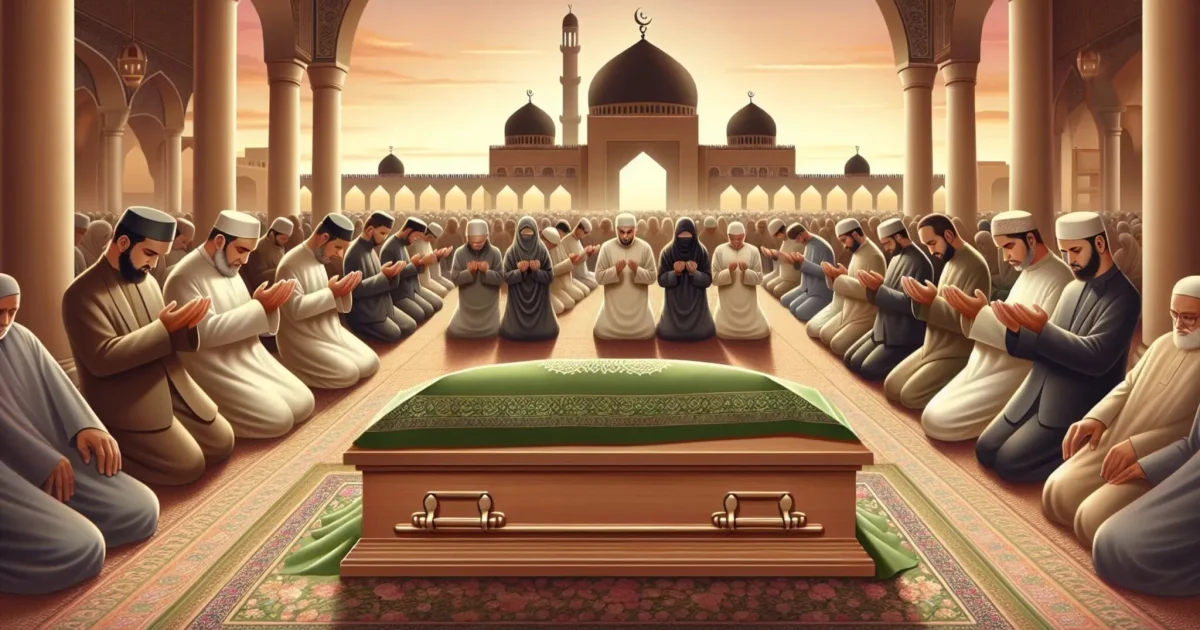
Salat al-Janazah is a collective obligation (Fard Kifayah). It consists of four takbirs with no ruku or sujud.
How to Perform Salat al-Janazah
- Make intention (niyyah) for the funeral prayer.
- Say the first takbir (Allahu Akbar) and recite Surah al-Fatihah.
- Say the second takbir and send salawat upon the Prophet ﷺ (e.g., Allahumma salli ‘ala Muhammad).
- Say the third takbir and make du’a for the deceased: “Allahumma ighfir li-hayyina wa mayyitina…” (O Allah, forgive our living and our dead…).
- Say the fourth takbir and make taslim (salam) to the right and left.
The Prophet ﷺ said: “When you pray over the dead, make sincere supplication for him.” (Sahih Muslim 949)
This prayer can be performed at the mosque, home, or cemetery. For local mosque services, check Masjid4All Business Directory.
Islamic Burial Procedures
The burial should take place as soon as possible after the funeral prayer.
Key Burial Requirements
- The grave must be dug perpendicular to the Qibla (direction of Makkah).
- The body is placed on its right side, facing the Qibla.
- Those present say: “Bismillah wa ‘ala millati rasulillah” (In the name of Allah and upon the religion of the Messenger of Allah).
- Three handfuls of soil are thrown into the grave while reciting: “Minha khalaqnakum wa fiha nu’idukum wa minha nukhrijukum taratan ukhra” (From it We created you, and into it We will return you, and from it We will bring you out another time).
- The grave is then filled and raised slightly above ground level.
The Prophet ﷺ forbade building structures or writing on graves. “The Messenger of Allah forbade plastering graves, sitting on them, or building over them.” (Sahih Muslim 970)
For more details on proper burial practices, refer to IslamQA’s guide on burial.
Practical Tips for Families
- Prepare a will (wasiyyah) that includes funeral preferences.
- Keep a funeral fund or inform family about burial expenses.
- Inform the local mosque or Islamic center immediately upon death.
- Arrange for Ghusl and Kafan supplies in advance.
- Recite Quran and make du’a for the deceased regularly.
- Visit the grave and give charity on behalf of the deceased.
Remember, the Prophet ﷺ said: “When a person dies, his deeds come to an end except for three: ongoing charity, beneficial knowledge, or a righteous child who prays for him.” (Sahih Muslim 1631)
Frequently Asked Questions
Can a woman attend the funeral prayer at the mosque?
Yes, women are allowed to attend the funeral prayer, but it is not obligatory. The Prophet ﷺ allowed women to attend, though it is recommended they maintain modesty and avoid overcrowding.
Is it allowed to embalm or cremate the body in Islam?
Embalming is generally discouraged unless required by law for transportation. Cremation is strictly prohibited in Islam, as it disrespects the body which must be buried intact.
What if the deceased died in a non-Muslim country?
Muslims should strive to arrange an Islamic burial even in non-Muslim countries. Contact local Islamic centers or Masjid4All for guidance. If no Muslim cemetery exists, a separate section in a public cemetery may be used.
How long can the funeral be delayed?
Islam emphasizes haste. The funeral should ideally take place within 24 hours. Delays without valid reason (e.g., waiting for relatives) are discouraged.
What should I say when visiting a grave?
The Prophet ﷺ taught: “Peace be upon you, O inhabitants of the graves, believers and Muslims. We will, Allah willing, join you. I ask Allah for well-being for us and you.” (Sahih Muslim 975)
Conclusion
Islamic funeral rites are a profound expression of faith and community. From the moment of death to the final burial, every step is guided by wisdom and mercy. By learning and implementing these practices, you honor the deceased and fulfill a sacred duty.
May Allah grant us the knowledge to practice these rites correctly and forgive our deceased loved ones. Ameen.
For further reading on authentic Hadith regarding funerals, visit Sunnah.com. For Quranic verses on death and resurrection, see Quran.com.
Still have questions?
Sofia can answer follow-up questions on this topic, point you to a mosque near you, or help with anything else on Masjid4All.
Ask Sofia about this