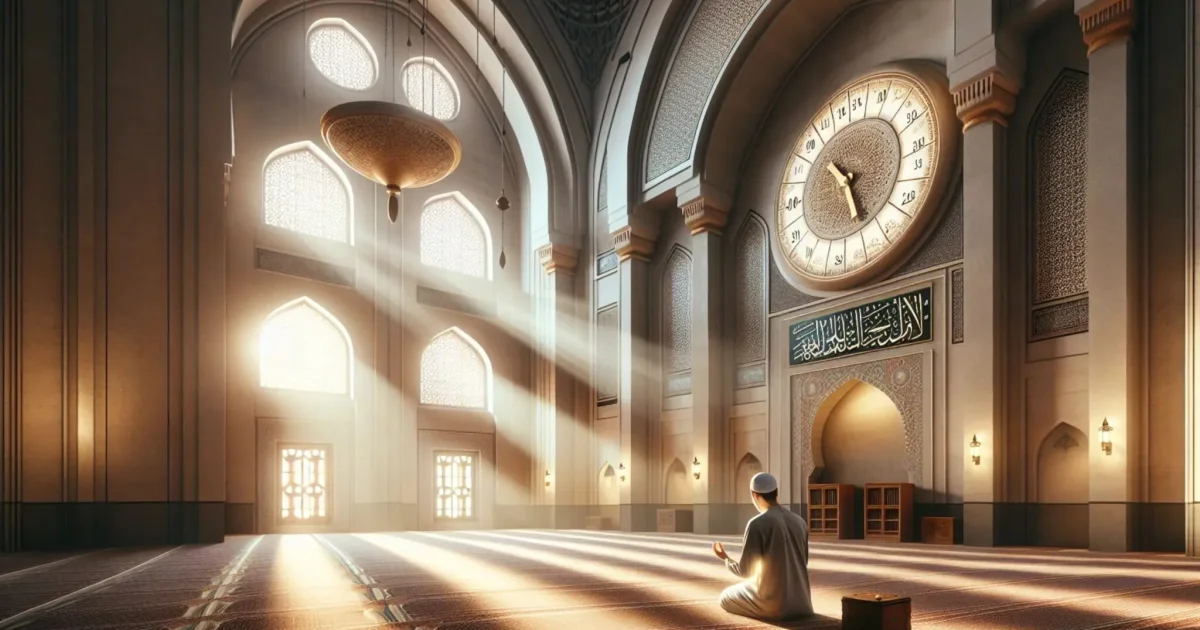
Understanding Prayer Times: A Complete Guide to Salah Timings
Understanding Prayer Times: A Complete Guide to Salah Timings
Prayer times are the backbone of a Muslim’s daily worship. Knowing the correct salah timings is essential for every believer. This guide explains the importance, calculation, and practical aspects of prayer times in Islam.
Table of Contents
- Why Prayer Times Matter
- Quranic and Hadith Evidence
- The Five Obligatory Prayer Times
- How Are Prayer Times Calculated?
- Common Methods and Angles
- Practical Tips for Observing Prayer Times
- Frequently Asked Questions
- Conclusion
Why Prayer Times Matter
Prayer times are a divine gift that structures a Muslim’s day. They remind us of our Creator and keep us connected to faith. Observing salah at its proper time is a sign of discipline and devotion.
Allah (سبحانه وتعالى) commands: “Indeed, prayer has been decreed upon the believers a decree of specified times.” (Quran 4:103). This verse highlights the fixed nature of prayer times.
Performing prayer on time brings immense blessings. It purifies the soul and strengthens community bonds. Many mosques use schedules based on accurate calculations to help the community.
Quranic and Hadith Evidence
The Quran and Sunnah provide clear guidance on prayer times. Allah says: “Establish prayer at the decline of the sun until the darkness of the night and [also] the Quran of dawn. Indeed, the recitation of dawn is ever witnessed.” (Quran 17:78). This verse outlines the periods for Dhuhr, Asr, Maghrib, Isha, and Fajr.
The Prophet Muhammad (ﷺ) demonstrated the exact timings. Sahih al-Bukhari records that the angel Jibril (عليه السلام) led the Prophet in prayer at the beginning and end of each time period. This Hadith is a key reference for calculating prayer times.
Muslims are encouraged to pray early. The Prophet (ﷺ) said: “The most beloved of deeds to Allah is prayer on time.” (Sahih al-Bukhari). This motivates believers to prioritize salah.
The Five Obligatory Prayer Times
Each of the five daily prayers has a specific window. Understanding these windows helps in planning your day.
- Fajr (Dawn Prayer): Begins at true dawn (first light) and ends at sunrise.
- Dhuhr (Noon Prayer): Starts after the sun passes its zenith and continues until the shadow of an object equals its length.
- Asr (Afternoon Prayer): Begins when the shadow of an object is twice its length (or equal, depending on school) and ends at sunset.
- Maghrib (Sunset Prayer): Starts immediately after sunset and lasts until the red twilight disappears.
- Isha (Night Prayer): Begins after the red twilight fades and continues until midnight (or dawn, according to some scholars).
These timings are observed universally, though local adjustments may apply. Many Islamic centers provide accurate schedules for their region.
How Are Prayer Times Calculated?
Calculating prayer times involves astronomy and jurisprudence. The position of the sun determines the start of each prayer. Modern methods use mathematical formulas to convert solar angles into clock times.
Key factors include latitude, longitude, and date. For example, Fajr begins when the sun is 18 degrees below the horizon (standard angle). Asr time uses the shadow length method.
Several organizations provide reliable calculations. You can find local schedules at your nearby masjid. Many apps also use these methods for daily alerts.
Common Methods and Angles
Different schools of thought use slightly different angles. The most common are:
- Islamic Society of North America (ISNA): Fajr 15°, Isha 15°.
- Muslim World League (MWL): Fajr 18°, Isha 17°.
- University of Islamic Sciences, Karachi: Fajr 18°, Isha 18°.
- Egyptian General Authority of Survey: Fajr 19.5°, Isha 17.5°.
These variations affect the start times slightly. It is best to follow the method used by your local community or mosque. For business owners, providing accurate prayer times can attract Muslim customers. Learn more at Masjid4All Business.
Practical Tips for Observing Prayer Times
Staying consistent with prayer times requires planning. Here are some helpful tips:
- Use a reliable prayer time app or website.
- Set alarms for each prayer, especially Fajr.
- Keep a printed schedule in your home or office.
- Join a local mosque for congregation prayers.
- Adjust travel plans to accommodate salah timings.
Remember, prayer is a spiritual anchor. Even busy professionals can integrate these timings into their routine. The key is intention and consistency.
Frequently Asked Questions
What are the exact prayer times for today?
Prayer times vary by location and date. Use a reliable Islamic calendar or app specific to your city. Many mosques publish daily schedules.
Can I pray before the official prayer time starts?
No, each prayer has a fixed window. Praying before the time is invalid. Wait until the calculated start time, verified by local sources.
What if I miss a prayer due to work or sleep?
You should make up the missed prayer as soon as possible. The Prophet (ﷺ) said: “Whoever forgets a prayer, let him pray it when he remembers.” (Sahih al-Bukhari).
How do prayer times change during extreme latitudes?
In regions with very long or short days, scholars recommend using the nearest city with normal timings or following Mecca time. Consult a local scholar.
Why do different mosques have slightly different timings?
Differences arise from varying calculation methods and angles. It is acceptable to follow your local mosque’s schedule for unity.
Conclusion
Understanding prayer times is a fundamental part of Islamic practice. Accurate salah timings help Muslims fulfill their obligation with ease. By learning the methods and relying on trusted sources, you can maintain a strong connection with Allah.
May Allah accept our prayers and grant us consistency. For more resources, visit Quran.com and Sunnah.com. For scholarly answers, refer to IslamQA. Implement these insights and experience the beauty of praying on time.
Still have questions?
Sofia can answer follow-up questions on this topic, point you to a mosque near you, or help with anything else on Masjid4All.
Ask Sofia about this